Business Workflow Automation in 2026: What Actually Works, What Fails, and Why

There is a gap at the center of enterprise automation strategy that nobody likes to talk about openly. The technology is more capable than ever. AI agents can reason, plan, and execute across complex systems with minimal human input. The case studies are compelling — banks cutting income verification from days to seconds, manufacturers reclaiming tens of thousands of hours annually, legal firms compressing weeks of document work into minutes. And yet, by most industry measures, somewhere between 70 and 80 percent of agentic AI initiatives still fail to move from controlled pilot to meaningful production deployment.
That gap — between what automation can do and what most organizations actually achieve — is the most important thing to understand about the automation landscape right now. It is not a technology gap. The tools exist. The platforms are mature. The gap is organizational, architectural, and strategic. And closing it requires a different conversation than the one most vendors are willing to have.
This article is that conversation.
The Shift Everyone Is Describing but Few Are Managing Well
When people talk about workflow automation in 2026, they are rarely talking about the same thing. That ambiguity is itself part of the problem.
At one end of the spectrum, a marketing manager building a Zapier connection between a form submission and a CRM entry is doing workflow automation. At the other end, Deutsche Telekom’s MINDR system uses a coordinated network of AI agents to manage network operations predictively — shifting from reactive troubleshooting to autonomous, real-time infrastructure optimization and compressing major network event response times from hours to roughly one minute. Both qualify as “automation.” The planning, investment, governance, and organizational change required are almost nothing alike.
The useful distinction is between task automation and agentic workflow orchestration. Traditional robotic process automation (RPA) was, at its core, an elaborate form of task automation. It excelled at mimicking the steps a human would take inside a GUI — clicking, copying, pasting, logging in — on highly structured, repetitive processes where the inputs were predictable and the exceptions were rare. When it worked, it worked well. When it hit something unexpected, it stalled and waited for a human to intervene.
Agentic AI operates differently. Instead of following a fixed instruction set, an agent pursues an outcome. It interprets the goal, formulates a plan, selects the right tools or APIs, retrieves the data it needs, makes probabilistic decisions, and escalates to a human only when its confidence falls below a defined threshold. A well-designed agent does not crash when a document format changes or when a customer’s request does not match a template. It adapts, because it is reasoning about the goal — not executing a script.
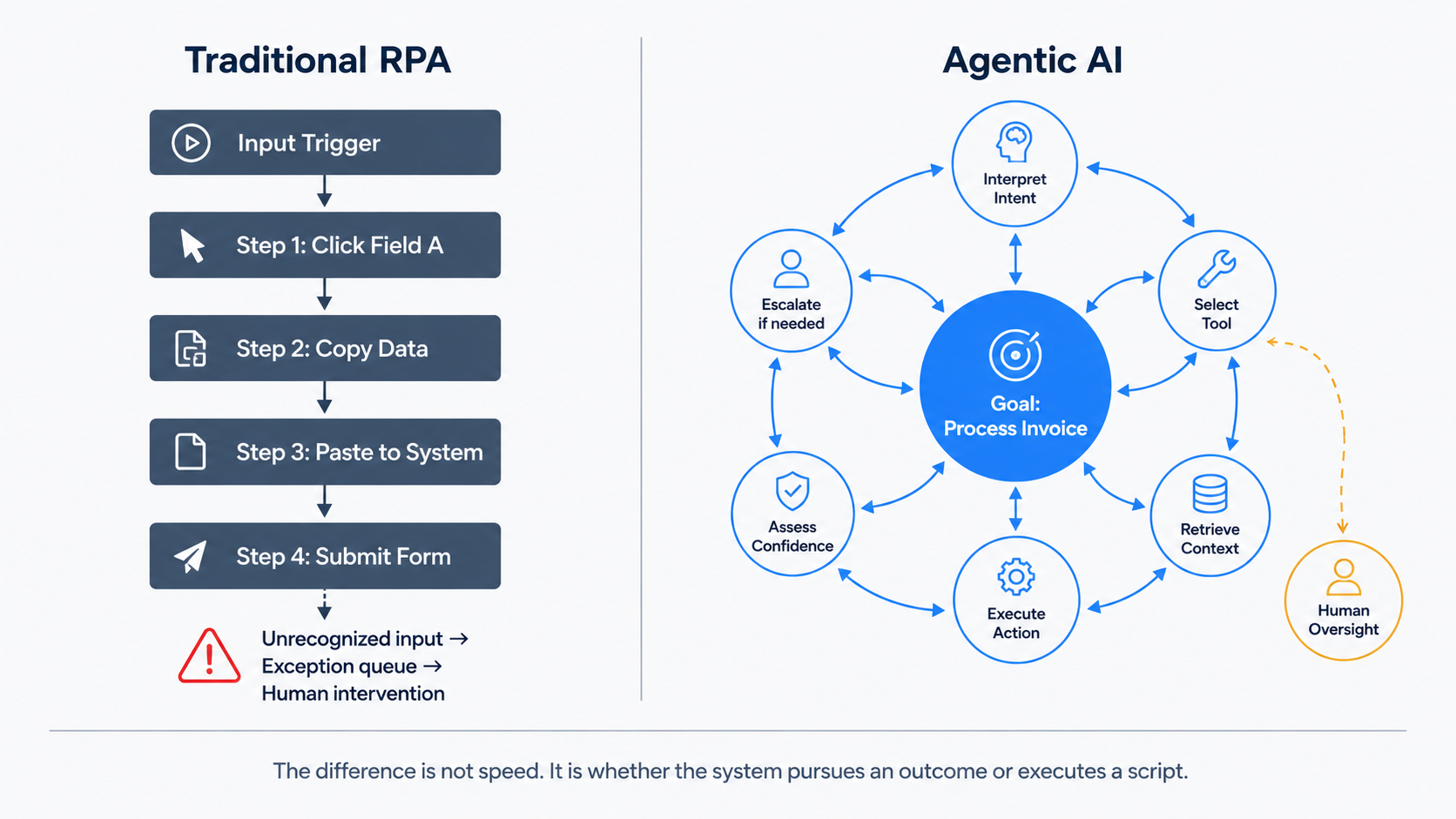
This architectural shift changes everything downstream: how you select platforms, how you govern deployments, how you measure success, and how you prepare your people.
Why the Majority of Programs Stall
The failure rate for agentic automation programs is high enough that it deserves an honest diagnosis, not a motivational sidebar.
The most common failure mode is not technical. It is the decision to automate before understanding the process being automated. Organizations deploy AI onto workflows they have never rigorously mapped — workflows that contain invisible bottlenecks, silent compliance risks, and expensive rework loops that the business has simply learned to work around. The AI does not fix these problems. It executes them faster, at greater scale, with less visibility into what is going wrong and why.
Process intelligence — the discipline of using system logs and operational data to reconstruct how workflows actually execute, rather than how they appear in documentation — is consistently underinvested in. Organizations that skip this step tend to discover their broken processes only after the automation is live and the exceptions are accumulating.
A closely related failure is what practitioners call agent sprawl: the proliferation of siloed AI agents deployed at the department level without any central coordination. One team builds a lead qualification agent. Another builds a customer outreach agent. A third builds a contract review agent. None of them know about each other. Data does not flow cleanly between them. When a handoff is required, a human has to bridge the gap manually — often via an email chain or a spreadsheet, which reintroduces exactly the inefficiency the automation was supposed to eliminate.
The third failure mode is governance treated as an afterthought. Autonomous AI agents interact with sensitive data, trigger real financial and commercial actions, and make decisions that carry legal and regulatory consequences. Only about one in five companies currently has a governance model mature enough to manage this responsibly. The other four are either running production automations without adequate controls, or they are so worried about the compliance risks that they cannot move out of the pilot stage.
Each of these failures is avoidable. None of them are inevitable. They are the result of implementation choices that can be made differently.
How to Choose an Automation Platform Without Getting It Wrong
The automation vendor landscape is genuinely confusing. The range runs from no-code tools any non-technical employee can learn in an afternoon to enterprise orchestration platforms that require dedicated engineering teams to configure and maintain. Marketing language obscures the differences. Most vendors will tell you their product handles enterprise scale. Most will downplay the implementation complexity.
The most useful filter is not features — it is organizational architecture. Specifically: who owns the automation program, and what systems does it need to touch?
Bottom-up programs, driven by business units and department managers who want fast results without IT involvement, are well-served by tools like Zapier, Make, or n8n. Zapier dominates the lightweight end: fast to set up, straightforward for linear integrations, and deep enough for most departmental use cases. Make (formerly Integromat) is better suited to teams that need complex branching logic and visual data transformation without the cost of enterprise platforms. n8n has earned a strong following among technical teams and automation agencies, partly for its “visual coding” model — which lets developers write custom logic directly into workflow nodes — and partly for its self-hosting option, which matters considerably for teams with data residency requirements.
Top-down programs, governed by enterprise IT and touching legacy systems, regulated databases, or complex AI models, require a different tier entirely. UiPath remains the dominant force for organizations whose processes depend on legacy mainframes or older applications without modern APIs — systems that simply cannot be reached any other way. Its ability to interact with user interfaces as a human would is genuinely irreplaceable in those contexts, and its Maestro orchestration layer provides the centralized control plane that prevents agent sprawl from becoming a crisis. Workato and Appian are better fits for organizations operating in cloud-native environments where the legacy UI scraping is not the bottleneck, but the coordination of many systems and data pipelines is. Microsoft Power Automate is the natural choice for organizations already heavily invested in the Microsoft ecosystem — the integration depth with Dynamics 365, SharePoint, and Office 365 is difficult to replicate elsewhere.
One platform category that deserves more attention than it typically gets is the operator-facing interface layer: tools like UI Bakery and Stepper that sit between a backend automation engine and the human employees who handle exceptions. A technically sound automation architecture can still fail operationally if the human exception-handling layer is managed through disconnected spreadsheets and Slack messages. When an agent cannot resolve something autonomously and escalates to a human, that person needs a clean, context-rich interface — not a raw data dump. Building this layer is often treated as a nice-to-have. It is not.
Governance Is Not a Compliance Checkbox — It Is an Engineering Requirement
The conversation about AI governance tends to happen in compliance and legal departments. It needs to happen in engineering teams before the first line of automation code is written.
The core challenge has shifted from access management to action management. Traditional IT governance asked: who can read this database, who can access this system? Modern AI governance must ask: what is this agent allowed to do, and under what circumstances, and with what human oversight? These are not the same question, and the tools that answer the first question do not automatically answer the second.
Four protections have become non-negotiable for any enterprise deploying autonomous agents against sensitive data.
First, data isolation from model training. Enterprise data must not flow into third-party model training pipelines. Modern architectures address this through AI Trust Layers that strip identifying metadata from prompts before external inference, maintaining a complete audit trail of every interaction.
Second, real-time PII masking. When agents process HR records, financial documents, or customer service workflows, they encounter personally identifiable information constantly. Advanced platforms now handle this by replacing sensitive elements — names, account numbers, social security identifiers — with reversible cryptographic tokens before the data reaches the model, and rehydrating the output within the secure enterprise perimeter. The agent never actually sees the raw PII. Neither does the model.
Third, zero-trust agent identity. An AI agent should inherit exactly the same role-based access controls as the human employee whose function it is performing — no more, no less. If a human accounts payable clerk cannot query the HR database, the AP automation agent should not be able to either. This sounds obvious. It is frequently violated in practice because agents are given broad permissions during testing and never properly scoped down before production.
Fourth, immutable audit trails. Every agentic decision needs to be logged: what triggered it, which model version executed it, the confidence level of the output, and the policy context at the time. This is not just about compliance — it is about operational transparency. You cannot debug, improve, or safely govern an automation you cannot trace.
Forrester’s projection that 60 percent of Fortune 100 companies will appoint a dedicated head of AI governance in 2026 reflects how seriously this is now taken at the board level. For organizations that have not yet formalized their AI governance posture, the question is not whether to do it — it is how quickly they can get there before a production incident forces the conversation.
What Real ROI Looks Like — and What It Takes to Get There
Automation return on investment is no longer theoretical. The documented case studies are specific, verifiable, and span enough industries that the pattern is now clear.
Lloyds Banking Group automated mortgage income verification using Google Cloud’s Vertex AI, reducing processing time from several days to seconds while deploying 18 generative AI systems into live production. M-DAQ Global used natural language processing to automate Know Your Business compliance workflows, improving customer verification productivity by a factor of 30 and eliminating severe manual bottlenecks in onboarding. Macquarie Bank reclaimed over 100,000 hours of employee time through AI-driven data unification. SS&C Blue Prism, which runs its own automation stack on its own products as what it calls a “Customer Zero” deployment, has documented over $200 million in cumulative internal savings.
In manufacturing, Toyota empowered factory floor workers to build and deploy machine learning models directly, saving more than 10,000 man-hours annually. A separate manufacturer automated order entry processing and achieved a 75 percent reduction in data entry time, reclaiming 1,200 FTE-hours per year. Games Global automated its administrative workflows — on-call approvals, employee onboarding, vendor management, security audits — and documented 22,370 hours saved annually. These are not headline-grabbing AI transformations. They are operational hygiene, executed well.
The numbers that should give decision-makers pause are the aggregate statistics rather than the individual success stories. Eighty percent of organizations set cost efficiency as their primary AI objective, and most are achieving it to some degree. But only 34 percent of enterprise leaders report using automation to genuinely reimagine their business models. Only 39 percent report a measurable impact on EBIT at the enterprise level. The gap between “we’re saving time on some tasks” and “this is changing how we compete” remains wide, and most organizations are still on the wrong side of it.
The organizations crossing that gap share a common approach: they start with a rigorous audit of what their processes actually cost, measured in time and money at the FTE-hour level. They target automation at the highest-value bottlenecks, not the easiest ones. They build orchestration infrastructure before deploying multiple agents. And they define what success looks like in financial terms before the first deployment, so they have something concrete to measure against.
The Workforce Question Deserves a More Honest Answer
The displacement narrative around automation is persistent, emotionally charged, and — based on actual 2026 workforce data — significantly overstated for most organizations right now.
Forty-three percent of organizations surveyed do not expect any change in overall headcount as a result of automation. Thirteen percent expect to hire more people, largely to fill new roles that did not exist before: AI system auditors, prompt engineers, orchestration architects, human-in-the-loop decision specialists. Thirty-two percent expect headcount reductions, which is real and worth acknowledging honestly — but it is not the majority response, and it is concentrated in roles defined almost entirely by high-volume, repetitive data handling.
The more pressing workforce challenge is skill readiness. Deloitte identifies the AI skills gap as the single largest barrier to deep automation integration. Gartner projects that 75 percent of enterprise hiring processes will require formal AI proficiency credentials by 2027. Targeted upskilling — not organizational restructuring — is currently how most companies are responding.
What that upskilling actually involves is worth being specific about. The skills that matter are not general “AI literacy” in the abstract. They are practical capabilities: knowing how to write a prompt that produces reliable, auditable agent behavior; understanding how to read an orchestration log and identify where a multi-agent handoff broke down; being able to evaluate whether a process is a good candidate for automation before committing engineering resources to it. These are learnable skills. They are also skills that organizations are not yet consistently teaching.
The honest message for employees navigating this is that the risk is real but narrowly concentrated, and the path forward is well-defined for those willing to engage with it seriously.
Chennai’s Quiet Rise as a Global Automation Delivery Hub
One development that does not get adequate coverage in Western technology media is the emergence of Chennai, Tamil Nadu, as a genuine center of excellence for enterprise automation architecture — not BPO labor, but specialized engineering.
The city hosts the global headquarters of Zoho Corporation, whose Creator platform and suite of integrated business applications underpin workflow automation for organizations worldwide. Kissflow, another Chennai-based company, has become a serious player in the enterprise low-code and workflow automation space, with a particular focus on non-technical users managing complex cross-system processes. Freshworks, headquartered in Chennai, provides automation-heavy customer engagement and IT helpdesk tools used by thousands of companies globally.
Beyond platform creation, the region has developed a dense ecosystem of specialized implementation partners. Nordia Professional Services holds UiPath Elite Partner status — one of the highest tiers in the UiPath Services Network — and specializes in SAP automation via API-level integration, bypassing the fragile UI scraping approach that most RPA deployments in legacy environments rely on. Alphavima Technologies has built a Microsoft Power Platform practice serving enterprise clients in Canada, the US, UK, Australia, and the Middle East, operating its technical delivery out of Chennai. Firms like AB7 Solutions, Transimply, MicroGenesis, and Gramosoft serve more bespoke needs — custom AI agent builds, n8n and Make deployments, and specialized integration work for clients who need flexible, agile implementation partners rather than large system integrators.
The macro pattern this reflects matters beyond Chennai specifically. Global enterprises are no longer just offshoring repetitive manual work. They are offshoring the architectural design, governance configuration, and continuous optimization of their autonomous AI systems — work that requires deep technical expertise and ongoing engagement. Regional hubs capable of delivering this at scale and at cost are becoming strategic assets in global automation supply chains.
Before You Deploy Anything: A Practical Starting Point
The research underlying this article points consistently toward one conclusion: sequence matters more than speed.
The organizations generating the most durable automation ROI are not the ones who moved fastest. They are the ones who invested in three foundations before building anything.
Process intelligence first. Use process mining tools to reconstruct how your workflows actually run — not how your process documentation says they run. The gap between the two is usually where the real cost is hiding, and it is almost always larger than expected. This audit also gives you the baseline metrics you need to measure ROI accurately after deployment.
Orchestration architecture before scaling. Design the coordination layer — the centralized system that governs how your agents hand off to each other, how exceptions escalate to humans, and how the full workflow state is tracked — before you deploy agent number four or five. Retrofitting orchestration onto a sprawling, siloed agent ecosystem is technically possible and operationally miserable.
Governance requirements as engineering requirements. Define your data isolation rules, PII handling policy, audit log standards, and agent access controls in the same planning process where you define your workflow logic. These are not separate concerns that can be added later. They are constraints that shape how automation is built, which means they need to be inputs, not afterthoughts.
The competitive advantage in automation no longer belongs to organizations that adopt the newest models or buy the most powerful platforms. It belongs to those who govern well, audit honestly, and build for durability rather than for the demonstration.
The Bottom Line
Enterprise workflow automation has crossed from possibility to operational reality. The case studies are not projections — they are documented outcomes from organizations that have already done the work. The technology is genuinely capable of transforming how businesses operate across finance, manufacturing, legal, marketing, logistics, and every other function that involves repetitive decision-making at scale.
But the failure rate — high enough that it should be part of every serious vendor conversation — tells you something important about where the actual difficulty lies. It is not in finding a capable platform. It is in deploying one with sufficient process intelligence to target the right problems, sufficient architectural discipline to prevent fragmentation, and sufficient governance to operate safely at scale.
The organizations building durable competitive advantage through automation in 2026 are not necessarily the biggest or the best-resourced. They are the ones treating automation as a strategic discipline rather than a technology purchase. That distinction, more than any platform choice or AI model selection, is what separates the case studies worth emulating from the failed pilots nobody publishes.
This article draws on industry research, documented case studies, and vendor landscape analysis current as of mid-2026. Specific ROI figures cited reflect published organizational disclosures and should be treated as directional benchmarks rather than guaranteed outcomes for any given deployment.